
CREATIVE.NOTES / 千弦 · CHIZURU
Symphonic Suite: All Under Heaven
From conquering the world to returning to oneself
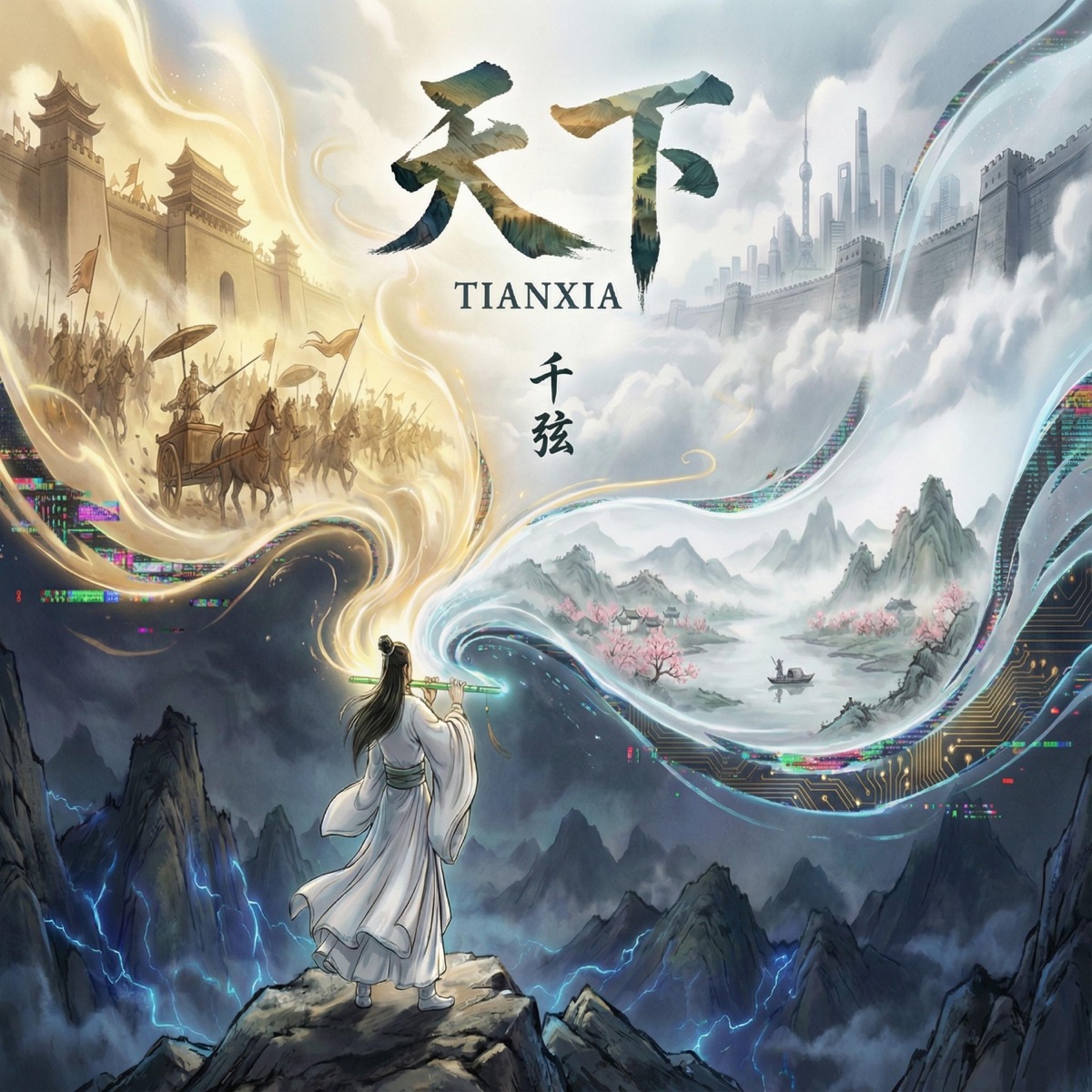
Is “all under heaven” the vast realm a sovereign surveys, or a cup of tea held in a recluse's hands? The same phrase can carry different weight at different moments in life. This question begins the suite: an expansive imperial narrative turns toward personal retreat, then opens into a contemplation of time and the universe.
The sixteen pieces do not trace the biography of a particular ruler or pass judgment on a period of history. The sovereign, the lost homeland, the cold river and the secluded paradise hold the rises and falls of a life: wanting to possess, experiencing loss, feeling daily life anew, and learning to exist within a wider world.
Four states, one changing perspective
Aspiration, waning, seclusion and transcendence are both the four movements and four ways of seeing. At first the gaze reaches toward distant territory and the highest position. Cracks in splendour reveal its cost. Leaving the centre of power returns the senses to pines, water and warm tea. Finally, even personal gain and loss enter the larger current of time.
The meaning of the title changes along this journey. At the beginning, expansiveness comes from possessing more; at the end, it comes from releasing the need to possess. Loss and relinquishment give the final stillness its weight. Each movement's four pieces retain their own images while carrying this transformation together.
I / THE ASPIRATION
Aspiration · 問鼎
The weight of power, the heat of ambition
The first movement belongs to life's most energetic and tireless phase. The world is not yet in one's hands, but the aim is clear: move forward and reach the summit. That passionate force is real, as are the pressure and weight that accompany it.
Four pieces take desire from emergence to its fullest expression. Darkness opens, contention begins, power takes shape, and splendour fills the view. 万国来朝 lingers inside a spectacle too beautiful to leave, passing a question to the next movement: when everything seems to have been gained, is the inner life fulfilled?
Through the pieces
鴻蒙初闢
Darkness before anything has taken shape begins the journey. A great impact opens an era and the possibility of action. Between waiting and release, life first reaches outward.
逐鹿中原
The trembling earth mirrors a racing heart. A distant, elevated goal intensifies the impulse to advance, bringing personal passion into a much larger struggle.
君臨九五
At the summit, passion becomes the weight of authority. Each step carries a historical echo; the coldness of imperial power exposes another face of victory.
万国来朝
Splendour reaches its height, like a magnificent illusion one does not wish to leave. Its beauty holds a quiet question about how long such apparent completeness can last.
II / THE WANING
Waning · 闌珊
What remains after the feast
The second movement changes first at the level of feeling. The feast continues, but its noise no longer fills the heart. Outward brilliance separates from inward emptiness, and a world that appeared unassailable begins to reveal its fragility.
From celebration to beacon fires, looking back at a homeland and finally leaving office, this movement makes the word “cost” tangible. Departure does not erase earlier passion. After seeing what has broken, a person begins to choose a different relationship with power.
Through the pieces
宴楽未央
Festivity seems to arrive through a veil of mist, revealing emptiness within abundance. The feeling changes before the fracture in the outer world is fully visible.
烽火連城
An apparently solid order meets the force of fate. Even an empire can be as fragile as a sandcastle; the strength accumulated in the first movement encounters its limits.
故国不堪
Looking back brings former ambitions into contact with a wounded landscape. The price becomes personal: what was gained also carries the weight of what was lost.
掛印封金
Rank and wealth are left behind for the wind ahead. Departure is this movement's clearest action, opening the path toward the return to oneself in the suite's second half.
III / THE SECLUSION
Seclusion · 帰隠
The breath of the landscape, the return of the self
Leaving the crowd does not make the world disappear. It makes the world easier to sense. Pines, water, footsteps and breathing replace feasts and public acclaim. The third movement returns attention to the body and everyday life, restoring a warmth that can be felt directly.
Seclusion becomes a rediscovery of one's own scale. Existence no longer needs to be confirmed from the highest position: a small boat or a cup of tea can hold a complete state of mind. 桃源一夢 carries that wish toward a pure image of life undisturbed by conflict and calculation.
Through the pieces
策杖聴松
The step grows lighter, and the sound of pines enters awareness. Attention once directed toward crowds and power comes to rest within nature.
寒江独釣
A vast world, a small boat. Solitude need not mean a lack of something. Away from others' expectations, a person regains time that belongs to them.
烹雪煮茶
Meaning settles into the warmth of a cup of tea. Grand ambitions recede, allowing small, tangible sensations to become precious again.
桃源一夢
A place without conflict or calculation holds the wish for undisturbed beauty. It gives life after relinquishment a direction to imagine and desire.
IV / THE TRANSCENDENCE
Transcendence · 坐忘
The river of time, the dust of the universe
Seclusion has recovered the self; transcendence takes one further step, placing that self within a wider time and universe. The earlier movements accompany one person's desire, loss and resettlement. The fourth moves beyond individual sorrow and joy toward the passage shared by all things.
Contemplation, flowing time and free wandering lead to 天下大同. The destination is inclusion and coexistence. The title returns, but its meaning has changed: the world one once wanted to hold becomes a world one can inhabit alongside everything else.
Through the pieces
観空一指
Deep stillness loosens the boundary between the immense and the minute. As the perspective rises beyond the individual, judgments of size and weight begin to shift.
逝者如斯
Beside the river of time, everything is seen to pass. Eternity becomes an awareness of change itself, rather than an attempt to keep one moment from leaving.
逍遥遠遊
The spirit moves like a bird above the clouds. What once constrained it gradually loses its weight; this journey leads toward inward freedom.
天下大同
A journey begun in contention closes with inclusion. Opposition gives way to coexistence, and the opening idea of “all under heaven” receives another answer.
A world beyond a single period
The cover brings ancient fortifications together with modern towers, pastoral landscapes with digital patterns. A flute player in the foreground preserves the scale of one person, while changing civilisations extend into the distance. The juxtaposition echoes the suite's movement from imperial narrative to the individual and then to the universe.
The four movements draw their imagery and reflections on life from Eastern culture, while the symphonic suite offers a form for distinct yet connected chapters. This meeting of cultural perspectives serves the same central question: how does a person see the world, and how do they find a place within it?
The final answer belongs to the listener
You can follow the four movements from passion toward stillness, or pause at the piece closest to your present state of mind. The programme offers a way into the work. What gives its images weight is the listener's own experience.
The work need not choose between a vast realm and a cup of tea on everyone's behalf. When the music ends, you might feel the impulse to travel, or the wish to stop and listen to the wind. Both feelings belong within All Under Heaven.
If you hear the clash of arms, it is the ardour in your heart; if you hear the silence of falling leaves, it is the stillness within you.
千弦 / Chizuru
Symphonic Suite: All Under Heaven
Album and complete tracklist